Rubik’s Cube Game: A Street-Art Stitch That Delivers
As someone who’s stitched hundreds of embroidery files for clients—from boutique apparel lines to Etsy sellers launching their first embroidered tote bag—I opened Rubik’s Cube Game expecting playful energy. What I got was sharper: a confident, modern interpretation of nostalgia with real stitching potential. This isn’t just another toy-themed machine embroidery design—it’s a visual statement that leans into texture, contrast, and attitude.
First Impressions: Bold, Graphic, and Unapologetically Craft-Forward
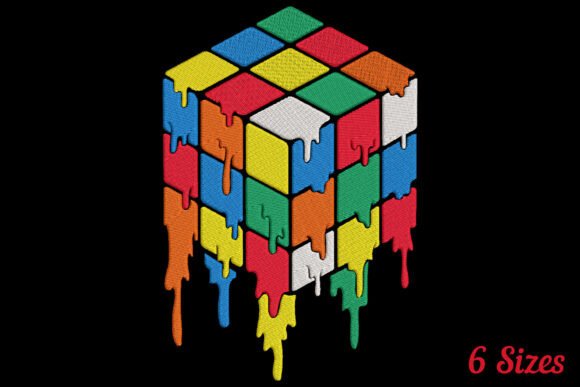
The moment you preview Rubik’s Cube Game, the melting paint effect hits—not as gimmicky distortion, but as intentional movement. The cube retains its iconic geometry, yet the softened edges and fluid color bleed suggest aerosol artistry, not pixelated clipart. It feels handmade before it’s even stitched. For craft business owners curating a cohesive line—say, a set of embroidered kitchen towels or minimalist baby onesies—the vibe reads instantly: clever, contemporary, and quietly subversive.
I tested it on a heavyweight cotton twill tote bag (a staple for my small shop clients), and the design held up beautifully at 4.2” wide. The balance between solid fill stitch areas and the more open, painterly zones gave depth without overwhelming the fabric. No dense thread buildup, no skipped stitches—even when I pushed the speed slightly on my mid-range commercial machine.
Where It Shines (and Where It Asks for Thought)
Rubik’s Cube Game thrives where personality matters most: custom apparel, embroidered patches, and boutique merchandise. On a charcoal sweatshirt? It pops with street-art confidence. As a centered chest patch on a denim jacket? Instant conversation starter. On a linen tea towel? Surprisingly elegant—especially when stitched in muted teal, rust, and cream thread colors instead of primary brights.
But here’s what I noticed in real use: the “melting” detail relies on subtle stitch direction shifts and tonal variation. That means it performs best on stable, medium-weight fabrics—think canvas, quilting cotton, or structured knits. On thin t-shirt jersey or stretchy baby interlock, I recommend testing with extra cutaway stabilizer and possibly simplifying the outermost melt edge in your editing software if clarity suffers.
Caps and curved surfaces? Proceed with caution. The top corner of the cube has gentle tapering that can distort on a low-profile cap front unless hooped *very* precisely—and even then, I’d suggest using it only on structured, pre-curved caps (not soft unstructured ones). For baby embroidery or nursery decor, it works well on crib bumper covers or pillow covers—but avoid placing it near seams or high-flex zones where repeated washing might stress fine satin-stitched transitions.
What Customers Actually Respond To
I added Rubik’s Cube Game to three holiday gift listings last season: a personalized sweatshirt for teens, a reversible embroidered patch for pin collectors, and a limited-run set of aprons for a local board game café. Feedback was consistent: “It looks like something from a gallery, not a craft fair,” and “My kid recognized it instantly—but said it looked ‘cool,’ not ‘kiddie.’” That duality is rare. It bridges generations without leaning on cliché.
That translates directly to perceived value. Buyers pay more for handmade product when the design feels intentional—not just applied, but *integrated*. Rubik’s Cube Game supports that. Its clean silhouette scales well for digital embroidery file previews and printable mockups, helping Etsy sellers showcase it realistically across light and dark fabric backgrounds. And because it avoids tiny lettering or micro-detail, it holds up in black-and-white mockups too—a quiet win for branding consistency.
Practical Designer Notes You’ll Want to Keep Handy
- Always test on scrap fabric first—especially with textured weaves or dark backgrounds. The melting effect gains or loses impact depending on how thread catches the surface.
- Review stitch density visually, not just numerically. This design uses smart layering: heavier fill in the cube core, lighter running stitch in the drip zones. If your machine struggles with density jumps, consider splitting layers manually.
- Confirm hoop size early. While it fits standard 5x7 hoops comfortably, the visual weight benefits from at least 4” of width—so avoid shrinking it below 3.5” unless you’re using it as a subtle accent.
- Inspect small details at actual stitch-out size. The corner transitions between colors are tight but legible. If your thread tension runs loose, those edges may blur—so check tension before committing to a full run.
- Use proper stabilizer: medium-weight cutaway for knits, tear-away for stable wovens. Skip the lightweight mesh—it won’t support the dimensional flow of the paint effect.
- Verify licensing before selling finished items. As a Toys Games–themed embroidery file, confirm whether commercial use is included—or if attribution or royalties apply. When in doubt, contact the seller directly.
- Try it in monochrome. Stitched entirely in charcoal-gray thread on oatmeal linen, Rubik’s Cube Game became unexpectedly sophisticated—a reminder that this design isn’t locked into its “fun” persona.
Final Thought: Not Just Another Cube—A Design That Earns Its Place
There’s a quiet professionalism in Rubik’s Cube Game that many playful embroidery files miss. It doesn’t shout. It doesn’t overcomplicate. It simply *works*: as a standalone statement on a tote bag, as part of a curated set of holiday embroidery, or as a signature motif for a craft business building brand recognition. For small shop owners and Etsy sellers, that reliability is gold—it reduces returns, boosts repeat orders, and makes photography easier (fewer touch-ups needed in post).
If you’re evaluating this machine embroidery design for your next batch of custom apparel or handmade product, trust your eye—but also trust your needle. Run that test stitch. Check the thread contrast. Feel how the stabilizer supports the melt. Then decide: does it elevate your work, or just decorate it? With Rubik’s Cube Game, the answer—nine times out of ten—is yes.