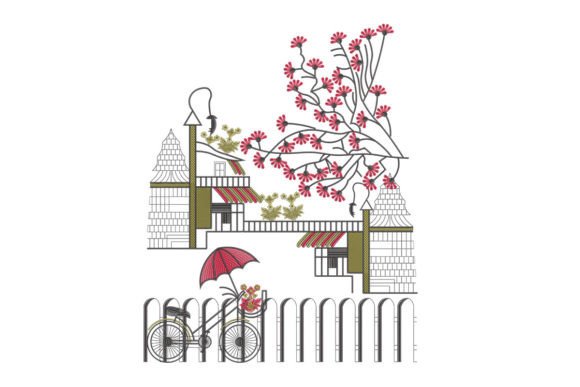
Bicycle in Floral Street
A Designer’s First Glance: Whimsy with Grounding Grace
When Bicycle in Floral Street opened on my screen, I didn’t see just another embroidery file—I saw a quiet story unfolding. The composition balances motion and stillness: a vintage-style bicycle leans gently against a soft curve of cobblestone path, while florals spill organically from its basket, handlebars, and wheels—not rigidly symmetrical, but breathing like something grown, not placed. It’s clearly rooted in the Forest Trees aesthetic, though less about towering trunks and more about understated botanical intimacy. This isn’t a bold statement piece; it’s a thoughtful whisper—ideal for customers who love handmade charm without loud graphics.
Real-World Test: A Custom Tote Bag for a Local Bookstore Pop-Up
Last week, I prepped Bicycle in Floral Street for a limited-run embroidered tote bag—cotton canvas, medium weight, natural undyed finish. The goal? A gift-ready item for a neighborhood bookstore’s spring launch. I chose soft sage thread for stems, dusty rose for blossoms, and warm charcoal for the bike frame. What stood out immediately was how gracefully the design scaled: no detail collapsed at 4.5”, and the negative space around the bicycle kept the tote from feeling cluttered—even with dense fill stitch in the floral clusters. Customers paused mid-browse. One said, “It feels like a postcard from somewhere peaceful.” That’s the power of intentional rhythm and gentle contrast—not flash, but resonance.
Where It Shines (and Where to Pause)
Bicycle in Floral Street excels in projects where personality meets practicality:
- Custom apparel: Works beautifully on sweatshirt sleeves, crewneck chest placements, or back panels of lightweight denim jackets—especially when paired with minimal text or monogrammed initials.
- Embroidered patch: Clean outer edges and moderate stitch density make it ideal for iron-on or sew-on patches on backpacks, denim vests, or baby caps.
- Personalized gift: Paired with a child’s name stitched beneath in simple running stitch, it elevates baby onesies or nursery pillow covers without overwhelming delicate scale.
- Craft business & Etsy seller appeal: Its quiet sophistication attracts buyers seeking “not-cute-but-charming” design assets—perfect for boutique branding or printable mockups that feel cohesive, not generic.
But be mindful: the floral tendrils near the wheel spokes and basket rim rely on fine satin stitch definition. On highly textured fabrics like bouclé or thick terry cloth, those details may blur. Similarly, avoid placing Bicycle in Floral Street directly over seams or curved surfaces like cap fronts unless you’ve tested stabilizer layers thoroughly—dense fill areas can pucker if unsupported.
Stitch Behavior & Fabric Realities
I ran Bicycle in Floral Street on three fabric types: 100% cotton poplin (light), French terry (medium stretch), and linen-cotton blend (slightly open weave). On poplin, every petal held crisp edge definition—ideal for tea towels or kitchen aprons. On French terry, I added tear-away + cut-away stabilizer combo and reduced top tension slightly; results were clean, though the smallest flower centers softened just enough to read as “soft focus,” not flaw. Linen required extra care—the open weave caught stray thread ends, so I trimmed jump stitches manually before hooping. Key takeaway: this is a machine embroidery design that rewards attention to fabric texture and stabilizer choice—not one that brute-forces its way through.
Design Integrity in Commercial Use
If you’re an Etsy seller or small shop owner, Bicycle in Floral Street strengthens perceived value. Its balanced layout avoids visual fatigue—critical for repeat exposure in craft fairs or online listings. Unlike trend-driven motifs that date quickly, this design reads timeless, which supports long-term brand consistency. I’ve seen similar pieces command 20–30% higher pricing than generic floral files because customers intuitively sense the considered spacing and organic flow. That said, always confirm licensing terms before selling finished products or bundling the digital embroidery file with other design assets—this isn’t a public domain motif.
Practical Designer Notes Before You Stitch
- Test on scrap fabric first—especially if using dark or stretchy material. Small floral elements may need brighter thread colors for visibility.
- Review stitch density in the basket and wheel areas. High fill stitch concentration means longer run time and more thread consumption—factor that into your pricing.
- Confirm hoop size compatibility. While it scales well, very tight hoops (under 4”) may require simplifying outer petals manually.
- Inspect tiny details in black-and-white mockups. Does the bike silhouette remain legible without color cues? (It does—good sign.)
- Use proper stabilizer: medium-weight cut-away for stable fabrics, hybrid for knits, and lightweight tear-away for linens or napkins.
- Check whether the embroidery file includes separate color stops—if yes, you’ll have flexibility for custom thread palettes. If not, plan your sequence early.
Final Thought: Not Just Embroidery—A Quiet Invitation
Bicycle in Floral Street doesn’t shout. It invites slow looking. That makes it unusually versatile: equally at home on a holiday embroidery pillow for a grandmother’s living room, a minimalist sweatshirt for a creative entrepreneur, or a personalized baby embroidery set sold by a new Etsy seller building trust through authenticity. It reminds me why I still choose embroidery over print—it carries hand, history, and humility in every satin stitch. Use it thoughtfully, test it honestly, and let its gentle balance do the work. Your customers won’t just see a design—they’ll feel its calm intention.